Most of you have doubtless noticed that Vice is no longer just for R-rated fashion insights and snarky social critique. Over the last year or so, their photojournalism has significantly upped the ante, drawing attention to things wholly absent from traditional news sources. This month's Vice Magazine has a heartbreaking piece in it about the state of Detroit's public schools. Though I've often mentioned my affinity for exploring spaces of urban decay and abandoned buildings, public schools are not places that qualify as romantically desolate.
James Griffieon, the author, frames his photos of decaying classrooms and abandoned art supplies within the larger narrative of Detroit's tragic modern history: white flight that has depleted the urban tax base and pervasive bureaucratic corruption and contracts that defy logic. The combination has produced a grim landscape for the city's school system, leaving half the city's residents illiterate and undermining any chance for urban renewal. Griffieon's brief introduction opens the curtain for his telling photos, the young victims of failed urbanism in Detroit and its sad stuff.
Check out the article and some of the commentary. There's some real crazy racist bull being slung about who's to blame, though little of it very thoughtful. It's obviously a multifaceted issue, spun together over the last fifty years by the course of history as orchestrated by some very powerful people. Reading the book Middlesex a couple of years ago first opened my eyes about the tumultuous course of history in that very American motor city, and this article further feeds that interest. And weigh in! The commentary could use some more thoughtful, well-balanced response.
Showing posts with label urban theory. Show all posts
3.18.2009
Scholarly Vice
General Themes:
articles,
decay,
detroit,
education,
racism,
schools,
urban theory,
vice magazine
1.12.2009
Unknown Artists
Stumbled across this piece by filmmaker Matt McCormick and narrated by the now famous Miranda July from 2001. It seems to straddle the distinction between ironic and critical documentary film, as I find myself both amused and interested at the same time. The short film entitled "The Subconscious Art of Graffiti Removal" contends that graffiti removers are artists themselves, creating public works sometimes unknowingly that accomplish much the complexity and well, simplicity of many of the Abstract Expressionists. The film seems to have earned both praise and criticism, both flung widely across demographics including graffiti artists themselves and bystanders alike.
the subconscious art of graffiti removal (excerpt) from matt mccormick on Vimeo.
It won all kinds of awards back in 01, though despite my appreciation of Miranda July and her kindreds, I've never seen this. Have you? Any thoughts about whether this is genius or rubbish? It poses some interesting questions about the urban medium which is so prone to attracting contradictions; in fact, the film does a superb job of mirroring the nature of graffiti itself. I'm not sold on the idea of graffiti removal equalling the original artists' work in aesthetics or historical relevance, but it is an interesting spin on the issue. It suggests there may be some value in those mundane, neutral splotches increasingly clouding the surfaces of our cities, which is a rather optimistic scenario. I am one for optimism...but...still...
the subconscious art of graffiti removal (excerpt) from matt mccormick on Vimeo.
It won all kinds of awards back in 01, though despite my appreciation of Miranda July and her kindreds, I've never seen this. Have you? Any thoughts about whether this is genius or rubbish? It poses some interesting questions about the urban medium which is so prone to attracting contradictions; in fact, the film does a superb job of mirroring the nature of graffiti itself. I'm not sold on the idea of graffiti removal equalling the original artists' work in aesthetics or historical relevance, but it is an interesting spin on the issue. It suggests there may be some value in those mundane, neutral splotches increasingly clouding the surfaces of our cities, which is a rather optimistic scenario. I am one for optimism...but...still...
General Themes:
art,
graffiti,
matt mccormick,
miranda july,
public art,
tags,
urban theory
12.03.2008
E2 = MC BP
This actually has nothing to do with Einstein, which is good because it's hard to write exponents on the internet. But if you pretend the 2 up there is smaller and higher and then you use your thinking cap and decipher the code BP (Pssst! Brad Pitt!) then you will have solved the equation, leading you to the treasure, to bask in the glory that is the series on PBS called E Squared.
What does Brad Pitt have to do with it? Well apparently in his probably constant efforts to keep up with Angelina's do-gooding, Braddie has lent his voice to narrate this ongoing series on public television about sustainable design and culture. "Woah!" (That's what I first said when I caught it live on tv for the first time.)
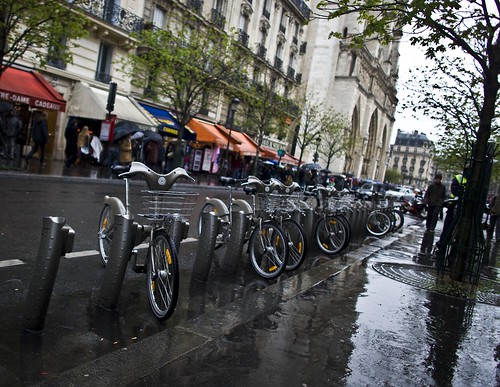
This season, the series offers three families of programming: design, energy and transport. Both are shot in the same cinematic, well sound-tracked, crisply pictured style and both are very very good. I write you about it now because the episode featuring Velo Liberte just went up on the website in the transport family. Perhaps you've already collected quite the earful about the great success of the French bicycle sharing program, but even if you are already familiar, you should still be able to appreciate the real spotlight and consideration the idea is given in this brief documentary piece. Especially in light of all the like-minded proposals gaining consideration in cities all over the world, this piece does a great job discussing the pros and cons, the obstacles and the successes of the notion.
If you have the time, I highly recommend the other pieces too, as there are several about New Orleans and one about the Federal Building here in San Francisco. They are all listed on the program's website under webcasts. While the series on its own merits makes a great addition to the PBS roster, the program represents a great way that the technology giant AutoDesk has contributed something decidedly un-commercial that is of very high quality. With my soft spot for pretty documentaries and predisposition to this sort of programming, I was an easy target. But since you read this blog, I'm betting you might be too. And to further bait you, even BSNYC had almost entirely nice, however snarky, things to say about the piece.
E2 has no embed! option on their player and the Velib' bit hasn't made it on to youtube yet, so I need you to trust me here and follow the link. They say it will only be available for a week, so you'd better just do it today. Right Now! Ready? 1, 2, 3...Go!
What does Brad Pitt have to do with it? Well apparently in his probably constant efforts to keep up with Angelina's do-gooding, Braddie has lent his voice to narrate this ongoing series on public television about sustainable design and culture. "Woah!" (That's what I first said when I caught it live on tv for the first time.)
This season, the series offers three families of programming: design, energy and transport. Both are shot in the same cinematic, well sound-tracked, crisply pictured style and both are very very good. I write you about it now because the episode featuring Velo Liberte just went up on the website in the transport family. Perhaps you've already collected quite the earful about the great success of the French bicycle sharing program, but even if you are already familiar, you should still be able to appreciate the real spotlight and consideration the idea is given in this brief documentary piece. Especially in light of all the like-minded proposals gaining consideration in cities all over the world, this piece does a great job discussing the pros and cons, the obstacles and the successes of the notion.
If you have the time, I highly recommend the other pieces too, as there are several about New Orleans and one about the Federal Building here in San Francisco. They are all listed on the program's website under webcasts. While the series on its own merits makes a great addition to the PBS roster, the program represents a great way that the technology giant AutoDesk has contributed something decidedly un-commercial that is of very high quality. With my soft spot for pretty documentaries and predisposition to this sort of programming, I was an easy target. But since you read this blog, I'm betting you might be too. And to further bait you, even BSNYC had almost entirely nice, however snarky, things to say about the piece.
E2 has no embed! option on their player and the Velib' bit hasn't made it on to youtube yet, so I need you to trust me here and follow the link. They say it will only be available for a week, so you'd better just do it today. Right Now! Ready? 1, 2, 3...Go!
General Themes:
bicycles,
biking,
documentary,
Paris,
pbs,
urban theory,
velo liberte
11.29.2008
David Simon, hero.
So, the sick irony of my off-handed comment regarding our favorite Big Box store yesterday has just settled in. But moments ago, I heard this absurd piece of news relating the tragic death by trampling suffered by one Walmart seasonal employee yesterday morning at a Walmart in Valley Stream, NY. The anxious crowd of shoppers apparently grew so out of control that the police had to be called in and even they could not assuage the near-rioting people. See, kids? Rampant capitalism is dangerous! Now it has claimed yet another life.
And in such cynical holiday spirit, I happened to watch the end of Season 3 of the Wire last nigth and man. Much as I feel like a chump for writing about television here, I make exceptions for things exceedingly relevant and exceedingly worthwhile. And frankly, if you haven't seen this genius show yet, I feel it my duty to persuade you: this show is one of the greatest things television has ever seen.

Since relocating to the West coast, I am constantly grasping at things to remind me what its like back east. I am terrified I will forget what a Philly accent sounds like. Watching the Wire not only takes me right back to the mid-atlantic, but its portrayal of Baltimore is so close to our bedraggled and beloved Philadelphia that it's pretty much a one stop shop when I'm feeling homesick. I'd go so far as to say that if you have never had the pleasure to visit one of America's decaying urban centers--Philly, Baltimore, Pittsburgh, St. Louis, Cincinatti--watching the Wire will get you at least half way there. Now don't get me wrong, they're each unique cities with very different landscapes, but our country's B-list cities share certain similarities. And the intricate complexities of Baltimore that play out in David Simon's show are many of the same things I associate with the FH home court. I'm no spoiler and it's not worth it for me to even begin to describe the infinite substance of the show. But recent history is on my side; the Wire isn't the only awesome thing lately to come out of Baltimore. And not to brag, but I got to see David Simon speak recently and it was hands down, one of the top ten things of my year.
Broken cities are more than just affordable. Frequently the cracks in the foundation, so to speak, create the very spaces for innovation. See: Braddock, PA
FH thrives in a creative community, a city of passion with relatively low cost of living because Philadelphia is a dysfunctional city. And we love that about it. A good friend of mine said recently that his own upbringing in a de-industrialized city may explain why he now calls the broken city of New Orleans his home. For the same reason, I find that I flock to other people, artists, writers and filmmakers who draw on the same multi-dimensional interest in understanding imperfect places. And it's no coincidence that David Simon's upcoming series, Treme is set in New Orleans.
It's often helpful to learn context, I find. And I'm offering up David Simon's cop drama as a facet of context for this little company. You may not understand what I mean until later, but that's okay. So long as the ball gets on rolling.
And in such cynical holiday spirit, I happened to watch the end of Season 3 of the Wire last nigth and man. Much as I feel like a chump for writing about television here, I make exceptions for things exceedingly relevant and exceedingly worthwhile. And frankly, if you haven't seen this genius show yet, I feel it my duty to persuade you: this show is one of the greatest things television has ever seen.
Since relocating to the West coast, I am constantly grasping at things to remind me what its like back east. I am terrified I will forget what a Philly accent sounds like. Watching the Wire not only takes me right back to the mid-atlantic, but its portrayal of Baltimore is so close to our bedraggled and beloved Philadelphia that it's pretty much a one stop shop when I'm feeling homesick. I'd go so far as to say that if you have never had the pleasure to visit one of America's decaying urban centers--Philly, Baltimore, Pittsburgh, St. Louis, Cincinatti--watching the Wire will get you at least half way there. Now don't get me wrong, they're each unique cities with very different landscapes, but our country's B-list cities share certain similarities. And the intricate complexities of Baltimore that play out in David Simon's show are many of the same things I associate with the FH home court. I'm no spoiler and it's not worth it for me to even begin to describe the infinite substance of the show. But recent history is on my side; the Wire isn't the only awesome thing lately to come out of Baltimore. And not to brag, but I got to see David Simon speak recently and it was hands down, one of the top ten things of my year.
Broken cities are more than just affordable. Frequently the cracks in the foundation, so to speak, create the very spaces for innovation. See: Braddock, PA
FH thrives in a creative community, a city of passion with relatively low cost of living because Philadelphia is a dysfunctional city. And we love that about it. A good friend of mine said recently that his own upbringing in a de-industrialized city may explain why he now calls the broken city of New Orleans his home. For the same reason, I find that I flock to other people, artists, writers and filmmakers who draw on the same multi-dimensional interest in understanding imperfect places. And it's no coincidence that David Simon's upcoming series, Treme is set in New Orleans.
It's often helpful to learn context, I find. And I'm offering up David Simon's cop drama as a facet of context for this little company. You may not understand what I mean until later, but that's okay. So long as the ball gets on rolling.
General Themes:
baltimore,
david simon,
philadelphia,
race,
television,
the wire,
urban theory
9.17.2008
Free Parking!
What to do when your city is lacking green space? When you've got all the spirit of an urban designer coursing through your veins and no clue how to satisfy her? While all the world is your stage? I think I may have the ticket.
Park(ing) Day, a one-day global event through which activists, artists, treehuggers--in a word, people--takeover metered parking spots and temporarily transform them into urban greenspace. They use bicycles usually, to haul plants and parkbenches and rolls of verdant sod through city streets where they literally park, for two hour chunks at a time, or as long as someone feeds the meter, and declare public space. The project takes place in TONS of cities all over the United States and internationally, with local variations depending on its ambassador and by the looks of things in 2007, warrants our undying praise and affection.
The project was founded by the San Francisco based art and activism collaborative REBAR and coordinated through the Trust for Public Land, an national nonprofit working to conserve public greenspace. The latter's website offers a list of participating cities, sometimes with corresponding maps denoting where the proposed park is to appear on Friday. They also provided instructions for obtaining permission and getting started with your own Park(ing) Day Park. I'd suggest visiting both websites for the full gamut of information surrounding what to do if you'd like to park come Friday. They've even made a How-To Manual. How can you say no? The whole effort is volunteer, which is pretty remarkable considering the scope and ambition of the concept. And in case you're having trouble picturing the thing, here is a visual:
and another:
Get out there! If Kenosha, WI can manage to be a part of this, I think you probably can too.
Park(ing) Day, a one-day global event through which activists, artists, treehuggers--in a word, people--takeover metered parking spots and temporarily transform them into urban greenspace. They use bicycles usually, to haul plants and parkbenches and rolls of verdant sod through city streets where they literally park, for two hour chunks at a time, or as long as someone feeds the meter, and declare public space. The project takes place in TONS of cities all over the United States and internationally, with local variations depending on its ambassador and by the looks of things in 2007, warrants our undying praise and affection.
The project was founded by the San Francisco based art and activism collaborative REBAR and coordinated through the Trust for Public Land, an national nonprofit working to conserve public greenspace. The latter's website offers a list of participating cities, sometimes with corresponding maps denoting where the proposed park is to appear on Friday. They also provided instructions for obtaining permission and getting started with your own Park(ing) Day Park. I'd suggest visiting both websites for the full gamut of information surrounding what to do if you'd like to park come Friday. They've even made a How-To Manual. How can you say no? The whole effort is volunteer, which is pretty remarkable considering the scope and ambition of the concept. And in case you're having trouble picturing the thing, here is a visual:
and another:
Get out there! If Kenosha, WI can manage to be a part of this, I think you probably can too.
General Themes:
activism,
art,
bicycles,
parks,
public art,
Rebar,
san francisco,
Trust for Public Land,
urban theory
Subscribe to:
Posts (Atom)